
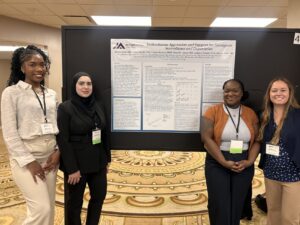
 After months of collecting data, analyzing results, and interpreting your findings, it’s finally time to share your research. Whether you’re presenting a poster at a conference, giving an oral presentation, or speaking to a community audience, presenting your work is an opportunity to contribute to the field while continuing to grow as a researcher. Check out our past workshop recordings on Paper to Conference Proposal and Developing a Conference Poster on the Research@MSP YouTube playlist.
If you’re preparing for your first presentation, remember that no one expects you to know everything. Your goal is not to be the world’s leading expert on your topic. It is to communicate what you learned and why it matters.
Know Your Audience
One of the first things I think about before preparing a presentation is who will be in the room. A presentation for fellow psychology researchers will look different from one given to clinicians, students, or community members. Tailor your language, level of detail, and examples to your audience so your findings are both understandable and meaningful.
Focus on the Story, Not Every Detail
It’s tempting to include every statistic, table, and methodological decision, but presentations aren’t manuscripts. Instead, think about the story your research tells. What problem were you trying to answer? Why does it matter? What did you find, and what should people take away from it? If your audience remembers one or two key messages after your presentation, you’ve been successful.
Keep Your Visuals Simple
Whether you’re designing a poster or creating slides, simplicity goes a long way. Avoid overcrowding your visuals with text and let figures, tables, and graphics do the heavy lifting whenever possible. Use headings, bullet points, and white space to guide your audience through your presentation rather than asking them to read large blocks of text.
Practice Out Loud
Reading through your presentation silently isn’t the same as presenting it. Practice explaining your research out loud several times before your presentation. You’ll quickly notice areas that sound awkward, sections that need to be shortened, or concepts that require a clearer explanation. Practicing with classmates, faculty mentors, or research team members can also help you prepare for questions.
Be Ready for Questions
Questions are one of the most valuable parts of presenting research. They often provide new perspectives, identify future research directions, and help you think more critically about your work. If someone asks a question you don’t know the answer to, it’s perfectly acceptable to say that it’s something you haven’t explored yet or that it represents an interesting direction for future research.
Network While You’re There
Conferences offer much more than presentation opportunities. Attend other sessions, introduce yourself to presenters whose work interests you, and don’t be afraid to start conversations. Many collaborations, mentorships, and future research opportunities begin with a simple conversation after a presentation.
Reflect Afterward
Once your presentation is over, take a few minutes to reflect. What questions came up repeatedly? Which parts of your presentation resonated with people? Did someone offer a suggestion that could strengthen your project or future manuscript? The feedback you receive can make your research, and your next presentation, even stronger.
Presenting your research can feel intimidating the first time, but it is also one of the most rewarding parts of the research process. Every presentation helps you become a more confident communicator, strengthens your understanding of your own work, and connects you with others who share your interests. Remember that your audience wants to learn from your work, and you’ve already done the hard part by completing the research. Now it’s simply your turn to tell the story.

Nosa Obaseki is a PsyD 4 student currently serving as MSP’s Research Graduate Assistant.